
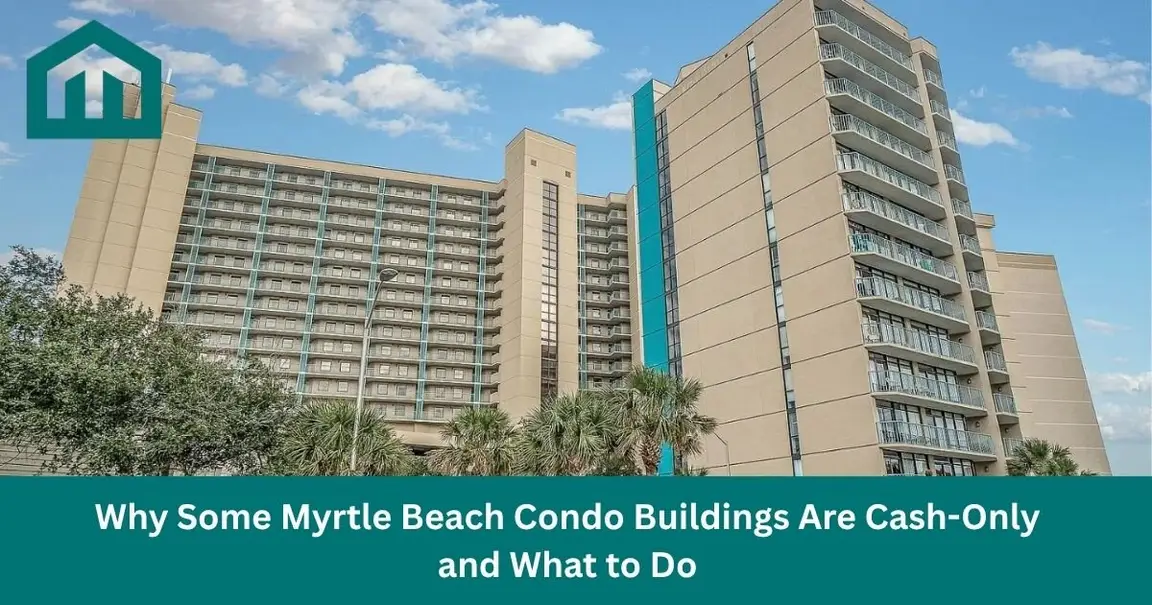
If your listing has sat for months with no offers, the problem may not be your unit. Lenders may have classified the whole building as non-warrantable, which cuts your buyer pool down to cash and a handful of specialty lenders.
The rules behind that classification changed twice in 2026 — once in your favor, twice against. Most of what you’ll find online is now out of date.
I’m Adam Seguin. My business partner Jeremy Resmer and I run Myrtle Beach Home Buyers, and together we’ve bought more than 400 properties across Horry and Georgetown Counties. Here’s where things actually stand.
Warrantable means the building qualifies, not you
A conventional lender won’t write a mortgage on a unit unless the whole project meets Fannie Mae and Freddie Mac standards. Your credit, your income, and your down payment are irrelevant to that test.
Fail one project-level criterion and every unit in the building becomes hard to finance, including yours. That’s why a well-kept unit in a struggling building can sit on the market while a worse unit two blocks away sells in three weeks.
Lenders check a system called Condo Project Manager. A project flagged “Unavailable” there is off the table before anyone looks at your kitchen.
The rule that just went away
Here’s the good news, and it’s genuinely good for the Grand Strand.
Fannie Mae retired the 50% investment property concentration limit in March 2026. For years, a building where more than half the units were rentals could fail warrantability on that basis alone — which described a lot of Myrtle Beach.
That test is gone for established projects. If someone told you your building is non-warrantable because it’s rental-heavy, that advice is now out of date, and it’s worth having a lender re-check.
One caveat: a presale requirement still applies to new and newly converted projects, where at least half the units must be conveyed or under contract to primary-residence or second-home buyers. Established buildings aren’t affected.
The $50,000 deductible cap: the sleeper risk here
Now the change that should worry Grand Strand owners most, and almost nobody is talking about it.
For loan applications dated on or after July 1, 2026, the maximum allowable per-unit deductible on a master property insurance policy is $50,000. A building whose master policy exceeds that fails the insurance test.
Look at why that matters here. Coastal master policies carry named-storm deductibles set as a percentage of insured value — commonly 2% to 5% — rather than a flat amount. On a large oceanfront building, a percentage-based deductible can translate into a per-unit figure well above $50,000. The association didn’t choose that number for fun; it’s what the coastal market offered.
So a building can become non-warrantable because of an insurance market it doesn’t control. This is the same pressure pushing regime fees and special assessments up across the Grand Strand, now showing up as a financing problem too.
If your master policy has a per-unit deductible, buyers also need their own unit-owner policy covering at least that deductible amount.
Limited Review is gone, and the reserve bar is rising
Two more dated changes worth knowing.
Limited Review retired. For loan applications dated on or after August 3, 2026, established projects must go through Full Review or a Waiver of Project Review. In practice that means every condo loan now requires the association’s budget, financials, reserve study, delinquency data, minutes, and insurance documents. Slow-moving boards and management companies become your problem.
Reserves going from 10% to 15%. For applications dated on or after January 4, 2027, projects reviewed under Full Review must budget at least 15% of annual assessment income to replacement reserves. Lenders also can no longer accept the baseline funding method in a reserve study.
There’s a separate hard fail worth checking: unfunded repairs to critical components costing more than $10,000 per unit that should be done within twelve months make a project ineligible.
One small piece of relief — Fannie also retired the requirement that roofs be insured on a replacement cost basis. Roofs must still be insured, but an ACV roof no longer fails the test by itself.
How to find out where your building stands
Ask your association’s management company for three things: the current budget with the reserve line, the master policy declarations page showing the per-unit deductible, and the last twelve months of board minutes.
Then call a local lender who does condo business and ask them to check the project’s status in Condo Project Manager. That call is free and takes minutes, and it’s the difference between guessing and knowing. If you’d rather not make it, call (843) 507-5058 and we’ll tell you what we find.
The real math: what cash-only status costs you
A worked example, not a specific sale. Say a two-bedroom unit worth about $260,000 in a warrantable building.
Scenario A — Push the board to fix it, then list. If the failure is documentation, a stale reserve study, or a reserve line a few points short, that’s fixable — and worth pursuing, because restoring conventional financing is worth far more than any price cut. But it moves at the speed of a volunteer board, and regime fees run the whole time.
Scenario B — List it as cash-only. Your buyer pool drops to cash purchasers and non-QM lenders, who typically want 10% to 20% down at rates above market. Fewer buyers and pricier money both push your number down, and Grand Strand condos already sit longer than single-family homes.
Scenario C — Sell to a cash buyer now. No project review, no CPM status, no waiting on a board.
The honest read: find out why the building fails before you decide anything. A paperwork problem is worth waiting out. A master policy deductible the coastal market won’t price lower is structural, and no amount of patience fixes it.
How we buy in non-warrantable buildings
Step 1 — Send us the building and unit. We pull the budget, minutes, and insurance declarations ourselves.
Step 2 — We identify the actual failure. If it looks fixable, we’ll tell you, because you’d net more selling after it’s fixed.
Step 3 — We show our math, including what we think the financing restriction costs.
Step 4 — You pick the closing date. No project review, so a building’s status doesn’t stop our closing.
FAQ
Q: What does non-warrantable mean for a condo? A: It means the project fails one or more Fannie Mae or Freddie Mac standards, so conventional lenders won’t finance any unit in it. It’s a building-level problem, not a reflection of your own credit.
Q: Is my building non-warrantable because it’s mostly rentals? A: Probably not anymore. Fannie Mae retired the 50% investment property concentration limit for established projects in March 2026, so rental-heavy buildings no longer fail on that basis alone.
Q: How do I find out if my building is warrantable? A: Ask a lender who does condo business to check the project’s status in Condo Project Manager, and request the budget, master policy declarations, and recent board minutes from your management company.
Q: Can a master insurance deductible make my building non-warrantable? A: Yes. For loan applications dated on or after July 1, 2026, the maximum per-unit deductible on a master policy is $50,000, and coastal named-storm deductibles set as a percentage of insured value can exceed that.
Q: Can my association fix a non-warrantable classification? A: Sometimes. Documentation gaps, stale reserve studies, and reserve shortfalls are fixable. An insurance deductible the coastal market won’t price lower is much harder.
Q: Who buys condos in cash-only buildings? A: Cash buyers, investors, and non-QM lenders offering specialty programs that typically require larger down payments at higher rates than a conventional loan.
The bottom line
Non-warrantable status is a building problem you’re carrying personally, and the rules moved in both directions this year. The rental-concentration test that hurt Grand Strand buildings is gone. The insurance deductible cap, the end of Limited Review, and the higher reserve floor all cut the other way.
Before you drop your price, spend an afternoon finding out which criterion your building actually fails. If it’s fixable, fixing it beats discounting. If it’s the master policy deductible, you’re selling into a cash market and should price accordingly.
Unit stuck in a cash-only building? Get a cash offer or call (843) 507-5058. If your building’s problem is fixable, we’ll say so.