
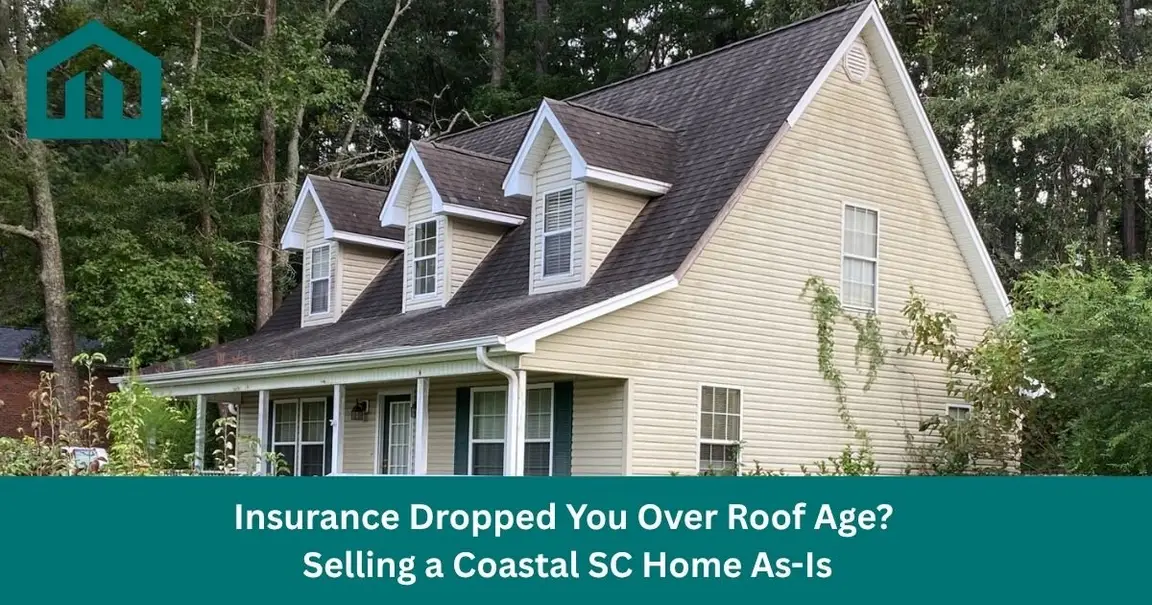
If your roof aged out and the carrier walked, you have three moves: replace it, sell as-is, or find out whether the Wind Pool will take you. The Wind Pool has its own roof condition standard, so it isn’t automatic.
And there’s a version of this that’s worse than a non-renewal letter, because it doesn’t come with one. Your carrier keeps you — but quietly moves your roof to actual cash value only.
I’m Adam Seguin. My business partner Jeremy Resmer and I run Myrtle Beach Home Buyers, and together we’ve bought more than 400 properties across Horry and Georgetown Counties. Roof age has become one of the most common reasons a Grand Strand house becomes hard to sell. Here’s how to think about it.
The two thresholds that matter: 15 and 20 years
Around 15 years, underwriting tightens. Some carriers stop writing new policies, an inspection gets required at renewal, and the premium climbs.
Around 20 years, a lot of the market closes. Many carriers won’t write a new policy at all, and existing policies face non-renewal — something we see constantly on older Surfside Beach houses.
Salt air and wind uplift are why. A shingle rated for 25 years inland doesn’t get 25 years three blocks off the Atlantic. Your roof can be watertight and still be uninsurable, because underwriting runs on age and condition reports, not on whether it currently leaks.
South Carolina law requires your insurer to give you advance written notice before non-renewing. Check the date on that letter — it’s your real deadline, and it’s shorter than most people assume.
The quiet version: they keep you, but switch you to ACV
Instead of dropping you, the carrier keeps the policy but changes roof coverage from replacement cost to actual cash value — depreciated value only.
The gap is severe. Depreciation schedules commonly run roughly 45–55% at fifteen years and 60–75% at twenty. On an $18,000 roof, replacement cost coverage pays close to the full amount after your deductible. ACV on a twenty-year roof might pay $4,000–$7,000. The rest is yours.
So if a named storm takes that roof off next September, you’re not covered the way you think you are. Pull your declarations page and look for the words “Replacement Cost” or “Actual Cash Value” on the roof line — the same distinction that decides what you collect on a storm claim. That single line decides a five-figure question.
The Wind Pool is not an automatic backstop
If a carrier drops your wind coverage, the South Carolina Wind and Hail Underwriting Association is the fallback — but it has underwriting and condition standards, and roof condition is one of them.
A roof that fails those standards can leave you with no wind coverage at any price. That’s the dead end: not expensive coverage, but no coverage, in a market where a financed buyer’s lender requires it to fund.
SC Safe Home grants — and the exclusion that catches most Grand Strand owners
South Carolina runs a real mitigation grant program through the Department of Insurance, and Horry County is one of the eligible coastal counties. The tiers:
- Up to $7,500 for roof work meeting both SC Safe Home and IBHS FORTIFIED Roof standards, certified by an independent evaluator
- Up to $5,000 for roof retrofits meeting SC Safe Home standards alone
- Up to $3,000 for hurricane shutters and opening protection
Now the part most articles leave out. The grant is limited to owner-occupied, single-family primary residences. Rentals don’t qualify. Second homes don’t qualify. Condos, duplexes, and multi-family don’t qualify.
On the Grand Strand, that excludes an enormous share of the houses with roof problems. If the property is your beach place, your rental, or a house you inherited and never moved into, the $7,500 you keep reading about isn’t available to you.
Two other traps: the program opens and closes in funding windows rather than running year-round, and the pre-mitigation inspection has to happen before any work starts. Start the roof first and you’ve disqualified yourself.
If you do qualify and you’re staying, apply. Call (843) 507-5058 if you want a second opinion on whether it’s worth waiting for the next window.
What a new roof actually does to your premium
Typical discounts run 5–15% for standard asphalt, 10–25% for Class 4 impact-resistant shingles, and 15–35% for metal. Real savings — but measured against a roof that costs five figures, the payback period runs long.
The honest argument for replacing isn’t the discount. It’s that you become insurable again, which restores the financed buyer pool. That’s worth more than the premium math suggests.
The real math: new roof or sell as-is
A worked example, not a quote. Say a Surfside Beach ranch with a twenty-year-old asphalt roof, non-renewal letter in hand, and an $18,000 replacement quote.
Scenario A — Replace it, then list. If it’s your primary residence and a grant window is open, a $7,500 award brings you to $10,500 out of pocket. Add four to eight weeks for the grant inspection, the work, and the FORTIFIED certification. Then list, less 6% commission — and the rest of what selling costs you. You’d likely recover part of the roof cost in sale price, rarely all of it.
Scenario A2 — Replace it with no grant. If the house is a rental or second home, you’re paying the full $18,000. That’s the version most Grand Strand owners are actually in.
Scenario B — Sell as-is. No roof, no grant paperwork, no inspection windows, no carrier. Your price reflects the roof, but you’re not fronting five figures on a house you’re leaving.
The honest read: if you live there, plan to stay, and a grant window is open, replace the roof. The math genuinely works, and it’s not close. It stops working when you’re not the occupant — no grant, full cost, and you’re spending $18,000 to recover part of $18,000 on a house you’re selling anyway.
How we buy homes with aged or failed roofs
Step 1 — Send us the address and the age of the roof. We don’t need an inspection report from you, whether the house is in Surfside Beach or Longs.
Step 2 — Tell us what your carrier said. If you were switched to ACV rather than dropped, that changes the picture, and it’s worth knowing before you decide anything.
Step 3 — We show our math, including what we’re budgeting for the roof.
Step 4 — You pick the closing date. We don’t need a wind policy to fund, so an uninsurable roof doesn’t stop our closing.
FAQ
Q: Can I sell a house with a 20-year-old roof in South Carolina? A: Yes, but expect a smaller buyer pool. A financed buyer needs insurance to close, and many carriers won’t write a policy on a roof that age near the coast.
Q: Why did my insurance company drop me over roof age? A: Coastal underwriting tightens around 15 years and closes for many carriers around 20. Salt air and wind uplift shorten a roof’s real life here, so age drives the decision more than current condition does.
Q: Will the SC Wind Pool insure a house with an old roof? A: Not necessarily. The Wind Pool has condition standards, and roof condition is one of them. A roof that fails can leave you without wind coverage at any price.
Q: Does a new roof increase my sale price by what it cost? A: Usually not dollar-for-dollar. The real benefit is making the house insurable again, which restores the financed buyer pool.
Q: Can I get a grant to replace a coastal roof in SC? A: Possibly — SC Safe Home offers up to $7,500 for FORTIFIED roof work in eligible coastal counties. But it’s limited to owner-occupied single-family primary residences, so rentals, second homes, and condos are excluded.
Q: My carrier kept me but changed my roof to actual cash value. Is that a problem? A: Yes. ACV pays depreciated value only, so a twenty-year roof might settle for a fraction of replacement cost. Check your declarations page for which one applies.
The bottom line
Roof age is an insurability problem, and insurability is what decides whether a financed buyer can close on your house.
Before you decide anything: read your declarations page for ACV versus replacement cost, note the deadline on your non-renewal letter, get one written roof quote from a local contractor, and check whether an SC Safe Home window is open and whether you actually qualify.
If you’re staying and you qualify, replace it. If you’re leaving and you don’t, spending $18,000 to sell a house is rarely the right answer.
Roof aged out and no carrier will touch it? Get a cash offer or call (843) 507-5058. If replacing the roof nets you more, we’ll tell you that instead.